New — Text in Paragraphs, with Indents and Tab Stops / Break Points After a Slash or a Hyphen / Every Linear Barcode on One Page / QR and Data Matrix Settings Side by Side
- Text in Paragraphs, with Indents and Tab Stops updated! ·
- Break Points After a Slash or a Hyphen updated! ·
- Every Linear Barcode on One Page ·
- QR and Data Matrix Settings Side by Side ·
Earlier Ones
- A PDF/A-1b Certificate of Employment ·
- A Tagged PDF/A-1a Deed of Deposit ·
- PDF/A-2b Minutes Kept for Thirty Years ·
- A Searchable PDF/A-2u Deed of Assignment ·
- A Tagged PDF/A-2a Notice of Rate Change ·
- PDF/A-3u Meter Readings with Their Table Attached ·
- A Tagged PDF/A-3a Schedule of Charges ·
- PDF/A-4 Terms of Carriage on PDF 2.0 ·
- A PDF/A-4f Statement with Its Data Attached ·
- Every Free Font, One Page Each ·
- A File That Explains Its Own Entries updated! ·
- What the Document Says about Itself updated! ·
- Text That Keeps to a Shape ·
- A Timetable That Reports on Its Own Layout updated! ·
- A Self-Paginating Table updated! ·
- A Template Whose Regions Are Filled by Name updated! ·
- A Table That Carries on from Page to Page updated! ·
- The Standards the Finished Document Is Measured Against updated! ·
- Two Signatures Added to a File Received ·
- A Row of Glyphs Asked for by Their Number ·
- A Watermark Laid across a Run of Pages ·
- Where a Page's Sheet Sits in the Drawing ·
- Files the Document Names without Carrying ·
- A Document Signed with a Demonstration Certificate ·
- An Agreement Received and Added to without a Byte Moved ·
- How Far a Supplied PDF Is Allowed to Unpack ·
- Four Kinds of Mesh, Every Corner Its Own Colour ·
- The Attachments Shown as a Portfolio ·
- The Notes a Program Leaves in the File for Itself ·
- The Notes a Program Leaves on One Page ·
- A Line of Words Set Along a Path ·
- A Statement with a Part Hidden Before It Is Released ·
- A Tender Pack of Three Lots ·
- The Notes a Program Leaves Itself ·
- Words That Follow a Curve ·
- Every Picture a Scanner Put in One File ·
- A Snag List, with Every Defect Marked on the Plan ·
- A Till Receipt on a Paper Roll ·
- An Invoice That Asks Before It Claims ·
- Ghostscript: The Second Checker of What a Page States ·
- The online editor: drop a PDF you already have, put what you want on top of it, and take away the request that creates it updated! ·
- Orphan Line: A Paragraph Starting at the Foot of a Page ·
- Widow Line: A Paragraph Ending at the Top of a Page ·
- The fine points of the two standards: what is settled, and what the checker actually looks at ·
- Showing Page One Before the File Has Arrived updated! ·
- A big document whose first page shows straight away: why a heavy PDF keeps somebody waiting, and what removes the wait ·
- Who writes this engine and who sells it: what a second supplier changes for you, and the six things we commit to ·
- Our licence in one page: what you may do with the engine, what you may not, and why your own code stays yours ·
- What you pay and for how long: every figure in public, what paying once means, and what a month renews into ·
- Changing the library that writes your documents: what you replace, what stays where it is, and the whole list of what we write today ·
- Badges of One Size, Names of Every Length ·
- A Delivery Note That Knows Its Own Order ·
- Two Orders, One Frame, One Bottom Edge ·
- veraPDF: the free program that says whether an archival document really is one, and the two uses made of it here ·
- Carrying a Font inside the Document updated! ·
- What comes back beside the document: how long it took, and what the engine remarked on while writing it updated! ·
- A Document That Asks for a Password Before It Opens updated! ·
- The Password That Opens It, and What May Be Done with It ·
- A Document That Reads Freely and Asks Not to Be Copied updated! ·
- Blocks Laid One under the Other, Page After Page ·
- A Drawing Declared Once and Placed as Often as Wanted ·
- The Attachments the Document Carries Beside Its Pages ·
- Which Attachments a Page Claims ·
- The Identity Card a Single Page Carries ·
- The Accessibility Standard the Document Claims ·
- What the Document Says It Is Made Of ·
- Fonts Whose Letters Cost One Byte ·
- How a Page Arrives, and How Long It Stands ·
- A Cell Repeated to Fill a Shape ·
- How Far a Supplied PDF Is Allowed to Unpack ·
- A Page Whose Letters Cost One Byte Each ·
- Archiving a document to open decades from now: what the standard asks, and who supplies what ·
- The library on your own machine, said three ways ·
- A Plan That Shows What Can Be Read ·
- What becomes of your documents, said three ways ·
- A Figure That Says Which Headings Reach It ·
- Prices Crossed out, a Shadow behind the Title updated! ·
- A Story That Carries on Further In updated! ·
- A Page and a Stamp inside Table Cells updated! ·
- The Watermark a Trial Copy Carries updated! ·
- A Handbook That Says How It Wants to Be Read updated! ·
- One Drawing, and Each Reader Sees Their Own updated! ·
- A Whole Novel in French updated! ·
- One Colour, Seen through Six Stencils updated! ·
- One Rule Instead of a Hundred Colours updated! ·
- A Gallery of Picture Formats updated! ·
- Internal and External Links updated! ·
- A Sheet Prepared for the Printing Works updated! ·
- A Month's Report, Its Charts Drawn in Curves ·
- One Letter per Recipient, All in the Same File ·
- Three Statements in One File ·
- Dashed and Dotted Lines ·
- A Page Set in a Font from 1990 ·
- The oldest font format, explained ·
- A Page That Carries No Font ·
- Letters You Draw Yourself ·
- A Report That Lays Itself Out ·
PDF documents for electronic invoices and for archives that must still open decades from now: as a library inside your own code, as a server on your own machines, or called over the internet.
Invoices, delivery notes, payslips, contracts, diplomas, labels: more than 130 finished examples, each one a click away.
-
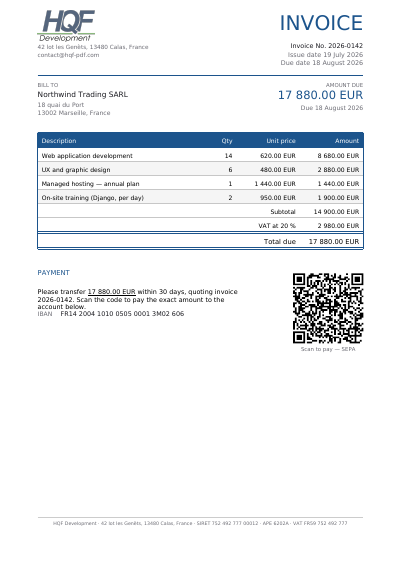 A Commercial Invoice
-
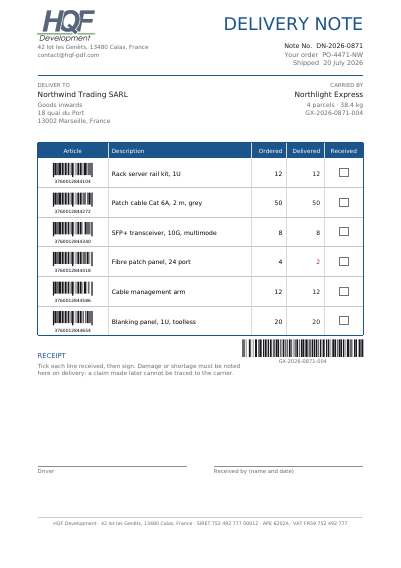 A Delivery Note
-
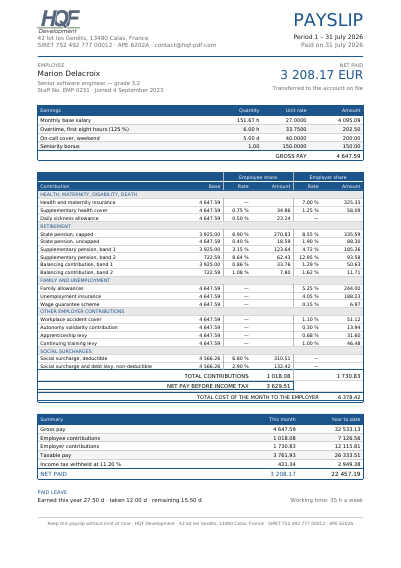 A Payslip
-
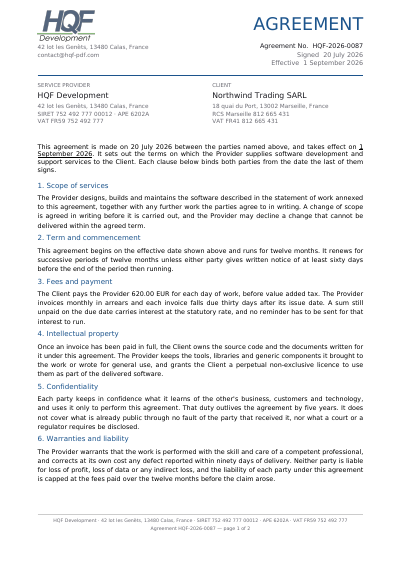 A Two-Page Services Contract
-
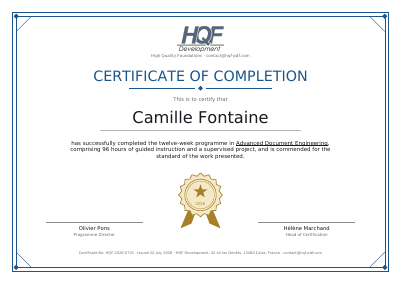 A Landscape Certificate
-
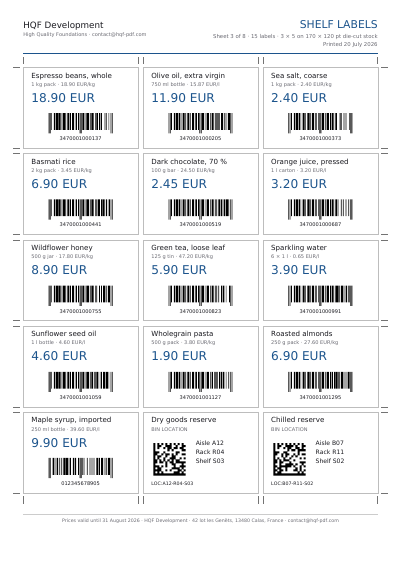 A Sheet of Shelf Labels
Since September 2026 every French business must be able to receive an electronic invoice.
Electronic Invoicing: The Dates, and What You Have to Send — what changed in September 2026, what an invoice has to carry now, and the file we already write.
The engine that creates an invoice also reads one you receive: it opens the PDF, extracts the file the invoice embeds under the name the standard sets, and hands those bytes to your own software. It also tells you whether the PDF meets the standard it claims.
A contract, a personnel file, an archive: a great many documents have to be still readable decades from now.
Keeping a Document Readable Decades from Now — what makes a document last, what makes it readable by someone who cannot see the page, and who checks that ours meet those rules.
We sell the library that creates those documents as PDF files. It goes inside the software you already have.
You can also have us create the document over the internet, with nothing to install. Either way you get the same documents, with text that flows across columns and pages, tables, images, barcodes and forms.
The online editor lays a document out in your browser: nothing to install, not a line of code. Create an account and use it on the free plan. Every page comes out with a watermark: wording written across it. Under the watermark the pages are laid out exactly as a paid plan lays them out, with one difference: every letter is traced as a shape instead of being written as text. No text on the page can be selected, searched or copied; the file carries no font, and it is heavier than the same page written as text. Tracing a letter needs its glyph, so a page comes out only when every font its text is set in is either sent with your request or already held by the service. The editor on this site and the examples on the API page are set that way. Anything else needs a paid licence: the service creates no document, and its answer names what was asked for and says a licence key covers it.
We are independent, and we mean to stay that way.
One company writes this engine and sells it, and that is what gives you a second supplier where you were down to one. What That Changes for You
Our licence is on the site, and your own code stays yours.
You never publish a line of what you write. Read the Licence Before You Buy
All our prices are on the site.
Read them and add up your year. What You Pay, and for How Long
Nothing to install? Ask us for the pages over the internet — the address it calls, what it sends, what comes back, every JSON key of a request, and the questions people ask first.
Prefer to create the pages on your own machine? The library — what it writes, its object families, the same code in Rust and in Python, and how it is licensed.
The Three Ways to Create a PDF, Side by Side — what moves, and where it moves to, in each of the three.
Changing Your PDF Library without Rewriting Everything — what you replace, what stays the same, and how long a change like this takes.
A Big Document That Opens Straight Away for the Person You Sent It To — four hundred pages, and the first one on screen before the file has landed.
Which of the three is for you?
Rent It by the Month
The Good Side
The quickest to start with: your first PDF document can come out today.
What to Keep in Mind
You pay every month, and your PDF documents pass through our machines.
Buy the Server and the Library
The Good Side
Your PDF documents never leave your premises, you pay once, and nothing has to reach the outside world.
What to Keep in Mind
It has to be set up on your machines — we work out with you who does it — and the whole price is paid up front.
Buy the Library
The Good Side
The lowest price to own, and you decide every last detail of what a PDF document looks like.
What to Keep in Mind
It takes somebody who writes programs, in Rust or in Python — two programming languages. If nobody where you work writes them, take the monthly plan instead: the online editor lays a document out in your browser, without a line of code.
What Each of the Three Includes
The same software is behind all three, so the table lists only what tells them apart: first what each way of buying puts within your reach, then what buying it one way rather than another means. What all three include is written out under the table.
| What You Get | By the Month from 14 € excl. tax a month 16.80 € incl. tax On our machines: you send a request, the finished PDF comes back, and you stop at the end of any month. There is a free plan. Every page comes out with a watermark. Use a watermarked document for your own work if it suits you: the watermark stays, and a paid plan is what takes it off. See the Three Monthly Plans By the Month | The Library 2 900 € excl. tax 3 480 € incl. tax Paid once. It goes inside your own program, which creates each page itself, on as many machines as you like. Ask for the Invoice The Library | The Server and the Library 5 900 € excl. tax 7 080 € incl. tax Paid once. Your program asks the server for a document and gets the finished PDF back, on your machines. The library is included in this price. Ask for the Invoice The Server and the Library |
|---|---|---|---|
| Make a PDF document ready for its seal: the signature area on the page and the exact space the seal goes into, which your own software then seals with your certificate | no | yes | yes |
| Open a PDF that already exists from your own program and read what it is made of: its pages, their size, what it declares about itself | no | yes | yes |
| A licence for life: paid once, and yours for good | Month by month, and you stop when you like | yes | yes |
| Pay once, then install it on as many machines as you like | Nothing to install anywhere | yes | yes |
| Bug fixes and minor versions are free for life; the day a new major version comes out you pay 50% of what your own licence cost you, and it stays 50% | Always the newest version | yes | yes |
| Your PDF documents stay on your own machines, first byte to last | no | yes | yes |
| One account: your own, on your own machines | no | yes | yes |
| Runs entirely on your own network, cut off from the world | no | yes | yes |
| Serve several of your own customers from one machine of yours, each with their own settings and their own fonts | no | no | yes |
| How many PDF documents you may create | 3 000 a month, or no ceiling at all | As many as your own machines can create | As many as your own machines can create |
Written Whichever Way You Pay for It
- Ready for the electronic invoice before the law requires it
- Codes read by a phone, a till or a scanner — to pay an invoice, track a parcel, board a train, price an item: QR code, DataMatrix, Aztec and PDF417, and the linear barcodes Code 128 and EAN-13
- PDF documents archives will still accept decades from now, and blind readers can read today
- Some of the lightest PDF documents around
- Take a PDF you already have and lay your own pages, stamps or headings over it
A monthly plan is paid by card: Stripe, our payment provider, takes the payment on its own secure page.
A licence bought outright is paid by bank transfer: your licence key is put in your account once the transfer has arrived, beside the invoice. A monthly plan has nothing to download: what you pay for is the service your own program calls over the internet.
Sold to companies and self-employed people only.
The two licences are paid by bank transfer, never by card. Ask for the invoice: it carries our bank details, and your licence key is delivered once the transfer has arrived.
Ask for an Invoice for the server and the library Ask for an Invoice for the library You need an account for that, and an account is free.
True of Every Offer Here, and of Everybody Else's
- One PDF document may be as long as you like: its pages are never capped
- The same request twice gives the same document twice, to the byte
- Two things differ from one request to the next: the moment the document was created, if you ask for it, and the lock, if you protect the document without stating the encryption key it must use
- Send the list of what the document must say, and get the PDF back
- We answer your questions by email
- Works where you work: Linux and Windows, from Rust or from Python
Found it cheaper somewhere else?
Tell us where, and we will match it. Write to us: we check the price you found, get back to you, and if it stands we match it at once. Either way, you hear from us.
Delivering It inside a Product You Sell
A licence covers the documents your own company creates. Delivering this engine inside a product you sell on to others is a licence of its own — a redistribution licence — and it is written with you rather than bought from a page. Write to us and we will set it out with you.