A minimal PDF
Two identical pages carrying the bones of an invoice in plain shapes, and not a word of text: a file of a dozen kilobytes, with no font embedded.
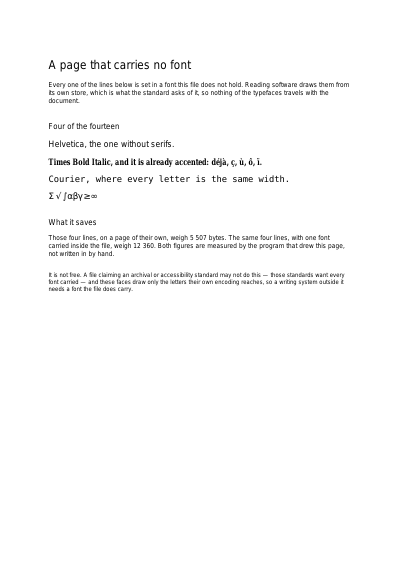
A font is somebody's property before it is a file, and putting one inside a document you hand to a customer is a question your lawyer will want to answer. It costs weight too, on every single document you produce. There has been a way round both since the beginning of the format: fourteen fonts all reading software has to draw on its own, whether the file brings them or not, and a document that asks for one of them writes a few lines naming it and nothing else.
The saving is not claimed here, it is measured: the same four lines are laid out twice, once this way and once with a font carried inside, and both figures are printed on the page you get. What it costs is printed there too. A file that claims an archiving or accessibility standard may not do this — those standards want every font carried, and the library refuses to write such a file — and each of these fonts carries a limited set of characters, so a writing system outside it needs a font the file really brings.
Nothing is left out and nothing is simplified: this is the program exactly as it runs, for the developer who uses this library. The third is the description itself: a plain list of what the page has to say, which is what the service is sent.
Read the Rust source Read the Python source Read the JSON source
Two identical pages carrying the bones of an invoice in plain shapes, and not a word of text: a file of a dozen kilobytes, with no font embedded.
The same document written twice, the ordinary way and with its first page moved to the head of the file, with how much of each must arrive before page one appears.
The same document written twice, plainly and packed, with what each one weighs and what the packing saved.
A page that opens with nothing typed and prints like any other, and that asks the reading software to leave its text where it is. Every word of it is scrambled inside the file.
A page nothing shows until its password is typed in: no first line, no preview, no picture of it anywhere. The password is given on the example's page, to be tried.
Text set in a font embedded in the file, cut down to the letters actually used, and still searchable, copyable and readable aloud.