A multi-page invoice table
Twelve invoice lines is one page and thirty is two, the second taking up the first's header and layout.
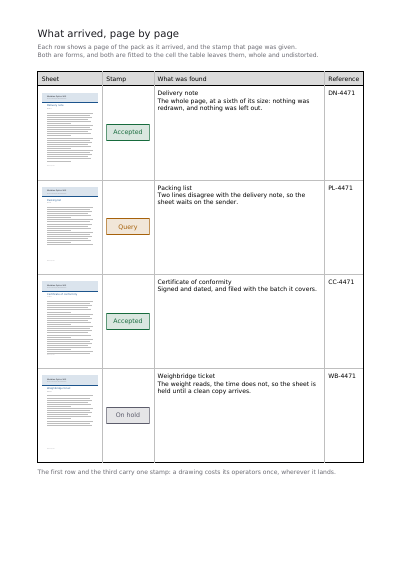
A supplier sends a pack — a delivery note, a packing list, a certificate, a weighbridge ticket — and somebody has to say, page by page, what was found on each one. The summary they write is usually a screenshot of every page, or the page retyped. Both mean the summary and the paper can disagree, and the day they do it is the summary that is believed.
Here each page goes onto the checking page as it arrived: the whole page, reduced to the size of a cell, not redrawn and not retyped. Beside it stands the stamp it was given. The stamp is drawn once and put on every row that needs it, so the file carries it once however many rows show it.
Nothing is left out and nothing is simplified: this is the program exactly as it runs, for the developer who uses this library. The third is the description itself: a plain list of what the page has to say, which is what the service is sent.
Read the Rust source Read the Python source Read the JSON source
Twelve invoice lines is one page and thirty is two, the second taking up the first's header and layout.
What a cell can do with its own rectangle: the margin, the border, the room inside, the background.
A cell's four sides in four different colours, and coloured fills told apart from coloured borders.
A long table handed over whole, deciding for itself where the pages break: its heading on top of every page, its footnote under every page, its grey grounds stated once for the whole table, and a note you draw under each page at the exact place the table reports.
A specification sheet whose cells are merged down the rows: each group named once beside all of its rows, with one note beside them; the thin lines stop at those cells' edges, and a note too long for the rows it covers makes them grow.
One parts list twice: four columns sharing the width equally, then the reference, the quantity and the price each as wide as their own widest cell and the description given everything they leave.