Breaking a Paragraph up, and Aligning It
A paragraph broken into lines, then laid out four ways: left, right, centred, justified.
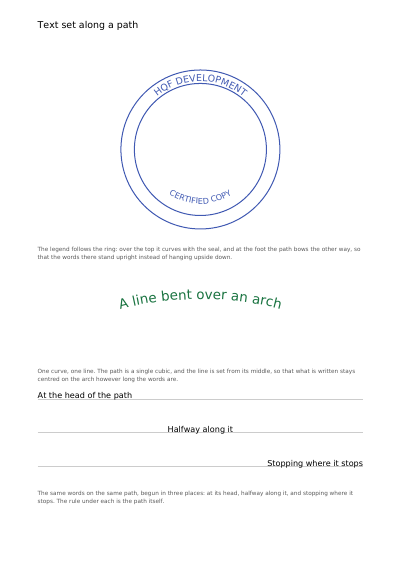
A stamp, a seal, a medal, a coin: the words on them run round the edge, and they have run round the edge for as long as there have been seals. Set as an ordinary line, those same words lie flat across the middle and the object is no longer the object. Here they are laid along a path, given in the very words a letter's own outline is given in, and each letter is turned to stand on it. The seal on this page carries its name over the top of its ring; at the foot, the path bows the other way, so the words there stand upright instead of hanging upside down.
The path is walked by length rather than by angle, so two letters an inch apart along the curve are an inch apart on the page whatever the curve does between them: a tightening bend never crowds them together. A line can begin at the head of the path, at its middle — which keeps the words centred on the curve however long they turn out to be — or at its far end, so that it stops where the path stops. The three thin rules at the foot of the page are three paths, each carrying the same sentence begun in one of those places, with the path itself traced underneath.
Nothing is left out and nothing is simplified: this is the program exactly as it runs, for the developer who uses this library. The third is the description itself: a plain list of what the page has to say, which is what the service is sent.
Read the Rust source Read the Python source Read the JSON source
Open the document in English Open the document in French Open the document in German Open the document in Spanish Open the document in Italian Open the document in Portuguese
A paragraph broken into lines, then laid out four ways: left, right, centred, justified.
A word longer than the column that holds it: the library leaves it whole, cuts it at the column's edge, or cuts it and closes the line on a hyphen.
A justified column set twice: the long words breaking at their soft hyphens with a hyphen shown, or left whole, and a figure a no-break space keeps together.
A justified column set four times: file paths and compounds running past the edge with no break points, wrapping where a break after a slash or a hyphen is allowed, then wherever their punctuation allows one, and last with no-break hyphens that keep each compound whole.
A title, a rule, two paragraphs, a heading, a table of twenty-six rows and a footnote, handed over in reading order and broken across two pages by the engine.
A delivery slip poured into two boxes, the second taking up where the first stopped, and a poster whose picture no box can hold, each box saying what became of the stack in it.