A Snag List, with Every Defect Marked on the Plan
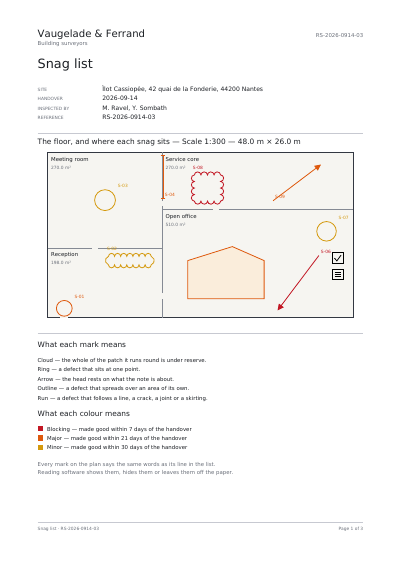
When premises change hands, the two sides walk the floor together and write down what is not finished. This is the sheet that walk produces. A plan of the floor comes first, with every defect marked where it sits; then the same defects one to a line, each with its room, what was found, how badly it stands in the way, the trade that answers for it and the date it is to be made good by; then three tables saying what the nine come to, gathered by degree, by room and by trade. Not a figure on it is typed in. A room's area is the rectangle the plan shows it as, read at the scale the plan is set to; a share is a count against the nine; a date is the handover plus the days that degree is given. Find a tenth defect and the plan, the list and the three tables all move together.
The marks on the plan are what sets this sheet apart from every other example here, and it is worth opening the file to see why. They are annotations: they stand above the page instead of inside what the page draws. Reading software therefore lists them on their own, one line per mark, and lets a reader jump to one, hide them all, or print the plan without them — and the plan underneath is the same plan either way. Five shapes are used, one for each way a defect shows itself: a cloud round a patch that is wholly under reserve, a ring on a defect that sits at one point, an arrow whose head rests on what the note is about, an outline round a defect that spreads over an area, and a run along one that follows a line. Each mark carries the words of its own line in the list, so what reading software speaks aloud is the sentence the list prints.
What This Example Shows
- A plan of the floor at 1:300, with nine defects marked where they sit.
- Five kinds of mark — cloud, ring, arrow, outline and run — each one standing above the page, and each carrying the words of its line in the list.
- Counts, shares, areas and dates all worked out: by degree, by room and by trade.
The Source Code, Complete
Nothing is left out and nothing is simplified: this is the program exactly as it runs, for the developer who uses this library.
The third is the description itself: a plain list of what the page has to say, which is what the service is sent.
Read the Rust source
Read the Python source
Read the JSON source
The Document Itself
Open the document in English
Open the document in French
Open the document in German
Open the document in Spanish
Open the document in Italian
Open the document in Portuguese