Where a Page's Sheet Sits in the Drawing
Move the sheet of one page across the drawing, so that two pages show the two halves of one spread.
See It in a Real PDF
A Sheet as It Goes to the Press
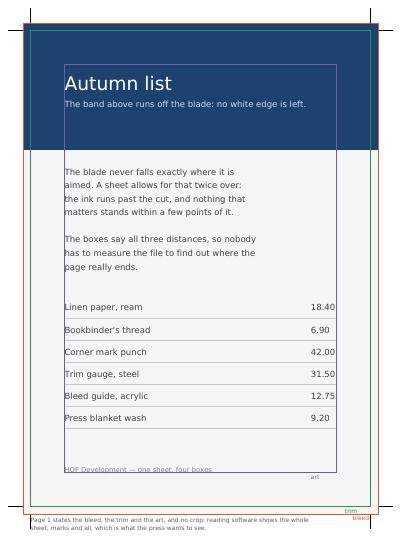
One drawing on four pages: a press sheet stating where the ink runs, where the blade falls and what is worth keeping, with trim marks; the same sheet cropped to the finished page; a landscape page that states a quarter turn clockwise on an upright sheet; and the first sheet again as the right half of a press sheet two pages wide.
Summary
Think of the drawing as one large sheet and of each page as a window cut out of it. Every window usually sits at the same spot, the bottom-left corner of the drawing. Here you slide the window of one page elsewhere, and that page shows another part of the same drawing. That is how a spread two pages wide is set once and printed as a left page and a right page, each showing its own half.
Technically
Written at the top level of a request, under
"page_origins"
page_origins names, page by page, the lower-left corner a page's sheet runs from. The sheet keeps the width and the height it was given and runs from that corner to the corner plus them. What the items draw keeps the coordinates it is drawn at, so a sheet moved off the origin shows another part of the same drawing. An entry says where a sheet sits, not that there is one: an origin named for a page past the end of the document leaves the document as long as it already was. A page named twice sits where the last entry given for it puts it.
Request Schema
-
page_origins— array, optional, empty by default. -
page_origins[].page— integer ≥ 1, required. The page the entry is for. -
page_origins[].x— number, required. How far right of the origin the sheet's left edge stands, in points. -
page_origins[].y— number, required. How far above the origin the sheet's bottom edge stands, in points.
A page nothing names runs from the origin, the point every other setting of a request is measured from.
A Whole Request That Creates a PDF
{
  "page": { "width": 420, "height": 595 },
  "page_origins": [{ "page": 2, "x": 420, "y": 0 }],
  "standard_fonts": [{ "name": "sans", "face": "helvetica_bold" }],
  "items": [
    {
      "type": "text",
      "rect": { "llx": 60, "lly": 280, "urx": 780, "ury": 320 },
      "content": ["One line running across a spread of two pages"],
      "font": "sans",
      "font_size": 28,
      "pages": [1, 2]
    }
  ]
}
The sheet, and what is laid under it
The Size of the Pages A Size of Its Own for Certain Pages The Unit a Page Is Measured In The Areas a Page States The Shapes a Page Lays over What It Draws Which Way up a Page Is Shown How a Page Arrives, and How Long It Stands A PDF You Send, as the Pages Themselves How Far a Supplied PDF Is Allowed to Unpack The Template under the Pages A Watermark Laid across a Run of Pages Named Regions a Page Marks for Filling
Where to Go Next
Every JSON key of a request, in one page The other forty-one settings of a request