A story that carries on further in

A newspaper puts three stories on its front page and finishes none of them there. On paper the eye manages: you read to the foot of a column, turn the sheet, and hunt for the heading again. On a screen that hunt is worse, because the column under the one you were reading belongs to a different story and looks exactly the same.

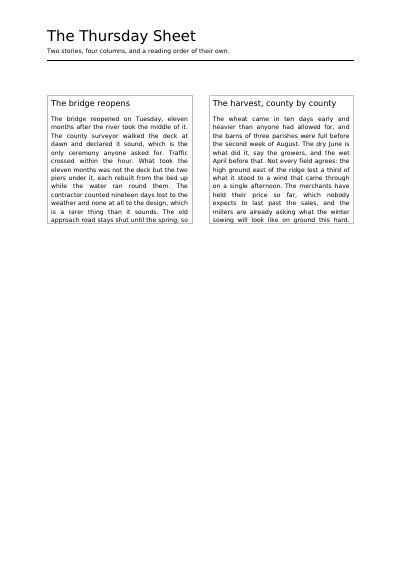
A PDF can say what belongs with what. Each story names the patches of page it is read through, in the order they are read, and a reader that follows one goes from the foot of a patch to the head of the next wherever it falls — the next page, the page after, the other side of the same sheet. The document below is a two-story newsletter, and the two swap sides between the pages on purpose: what you would read next by eye is not what you read next by following the story.

What this example shows

  • A story followed from one column to the next, across pages.
  • Several columns of one page belonging to different stories.
  • A title, an author and a subject shown beside each story.

The code that writes it, in full

Whole programs, hundreds of lines long, for whoever writes your software. The third is not a program at all: it is a plain list of what the page has to say, which the service is sent.

Read the Rust source Read the Python source Read the JSON source

The document itself

Open the document in English Open the document in French

First page of A story that carries on further in

What this document weighs

This document weighs 43.1 kB.

See what every document weighs.

The speed and weight figures on this site are measured with a licence key. See what a trial copy draws.

Details for technical readers

Exactly 43 073 bytes.

A kilobyte on this site is a thousand bytes.

Examples near this one

A slideshow that runs itself

A plain first slide and twelve more, each stating the effect it arrives by — the twelve the standard defines — how long that effect takes and how long the slide stands before the next one comes. The file asks to open full screen, which is where the effects play.

A handbook that says how it wants to be read

Four pages that say how they want to be opened: which page comes up and how much of the window it fills, the chapters beside it, the pages two at a time, a print box already filled in — every one of them a wish each reading program answers for itself.

Internal and external links

A document made to be followed rather than looked at: every line of the contents lands on the page it names, and every page leads back to where it came from.

Links and marks on placed text

Links and marks hung on text the engine has already placed: a band behind a line, an underline, a boxed cell — every rectangle taken from what the layout and the table report afterwards, none of it measured by hand.

A document that can be read aloud

Two pages carrying a copy of themselves that nobody sees: this is a heading, this is a table, and this is the order to read them in. Software reading the document aloud follows that instead of the order the marks were drawn in, and skips the running head. On the page, nothing looks any different.

Every example, by subject