The Accessibility Standard the Document Claims
Declare the document built to be read aloud and described, and have that claim checked against what it actually carries.
See It in a Real PDF
A Figure That Says Which Headings Reach It
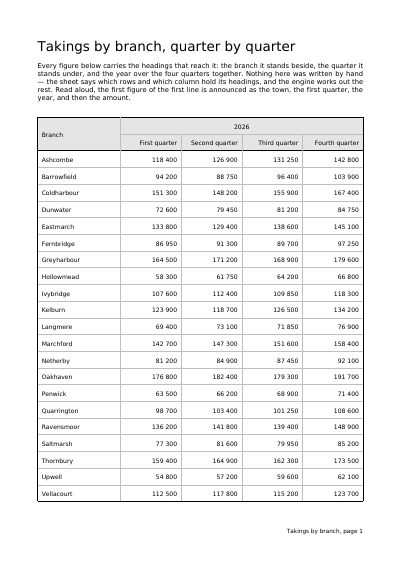
Takings for thirty branches, quarter by quarter, over two pages. Every amount on the page carries the headings it stands under: the branch beside it, the quarter over it, and the year over the four quarters together. Read aloud, an amount is announced by its town, its quarter and its year before the sum itself.
Open the PDF The Whole Example
Also shown in: A Payslip
Summary
Somebody who cannot see the page reads a document through a program that says it aloud. For that to work the file has to carry, beside the ink, what each piece of ink is: this is a heading, this is a paragraph, this is a picture and here is what it shows, this line is decoration and should be skipped. The check looks at the structure the document says it is made of, the furniture it leaves out, the fonts it carries and its title, and a document that does not hold up is refused rather than shipped saying something false. It is what decides a public-sector contract, where the claim is a requirement rather than a courtesy.
Technically
Written at the top level of a request, under
"accessible"
accessible states, in the XMP packet, the accessibility standard the document conforms to, and writes /MarkInfo. The claim is judged, not recorded: it is checked against the tree the document says it is made of, the furniture it leaves out of that tree, the fonts it carries and its title. The part chosen also fixes the version of PDF the file is written as, and no other — PDF/UA-1 is built on PDF 1.7, PDF/UA-2 on PDF 2.0, whose tree is rooted in one Document element named from the PDF 2.0 set of tags. It goes hand in hand with structure, which is what the check reads, and it stands beside archive rather than replacing it: a document may be both archival and accessible.
Request Schema
-
accessible— string, optional. Absent, the document claims nothing. -
pdfua1— ISO 14289-1, the part built on PDF 1.7. The file is written as PDF 1.7. -
pdfua2— ISO 14289-2, the part built on PDF 2.0, whose tree is rooted in oneDocumentelement named from the PDF 2.0 set of tags. The file is written as PDF 2.0.
Scope: the whole document. It fixes the version the file is written as, so it is refused beside a version that says otherwise. A document claiming a part it does not hold up to is refused when the request is read, not shipped with a claim that is false.
A Whole Request That Creates a PDF
One name below stands for a font file: put the encoded file in its place, or send the file itself beside the description, as a supplied part of the same call. One page carries a real font already encoded, and its request posts as it stands.
{
  "accessible": "pdfua1",
  "metadata": { "title": "A readable document" },
  "fonts": [{ "name": "body", "data": "PASTE_THE_FONT_FILE_BASE64_HERE" }],
  "structure": {
    "lang": "en-GB",
    "children": [
      {
        "tag": "Document",
        "children": [{ "tag": "H1", "content": "heading" }]
      }
    ]
  },
  "items": [
    {
      "type": "text",
      "rect": { "llx": 72, "lly": 700, "urx": 523, "ury": 740 },
      "content": ["A readable heading"],
      "font": "body",
      "font_size": 20,
      "tag": "H1",
      "mark": "heading"
    }
  ]
}
The document as a whole
The Numbers Reading Software Shows A Hundred Letters in a Single File What the Document Says about Itself What the Document Says about Itself, Said Once Text Nobody Can Copy The Notes a Program Leaves in the File for Itself The Notes a Program Leaves on One Page The Data a Program Hangs on a Run of Ink A File Still Readable Decades from Now The Print Standard the Document Claims The Variable Print Standard the Document Claims The Password That Opens It, and What May Be Done with It An Invoice a Person and a Machine Both Read The Address Relative Links Are Read Against The PDF Version the File Declares The Extensions to PDF the File Says It Uses What a Picture Says about Itself, and How It Is Read The Attachments the Document Carries Beside Its Pages Files the Document Names without Carrying The Attachments Shown as a Portfolio Which Attachments a Page Claims Which Attachments a Font Claims The Identity Card a Single Font Carries Which Attachments the Document's Card Claims A Document Card Written Elsewhere The Areas of a Page a Reader Measures In The Identity Card a Single Page Carries The Standards the Finished Document Is Measured Against
Where to Go Next
Every JSON key of a request, in one page The other forty-one settings of a request