A minimal PDF
Two identical pages carrying the bones of an invoice in plain shapes, and not a word of text: a file of a dozen kilobytes, with no font embedded.
A font file holds letters somebody else drew. Sometimes what a document needs is a mark nobody drew for you: your own logo, the tick your quality sheets use, a symbol your trade has and Unicode has not. The usual answer is to drop a picture in at every occurrence and then work out by hand how far to move along before the next word — which comes apart the day the text is translated or the size changes.
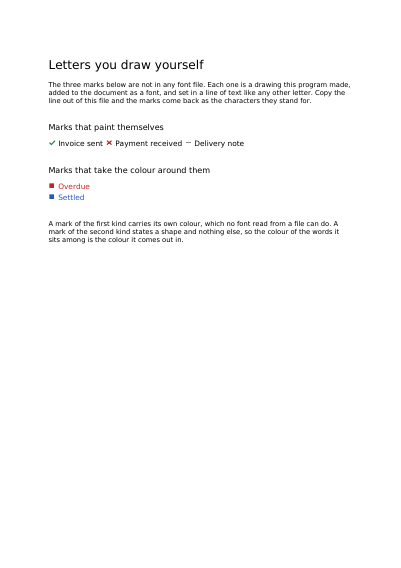
Here the marks are drawn by the program itself and set among the words like any letter, so they move with the text instead of being put back by hand. Two things follow. A mark can carry its own colour — the tick comes out green and the cross red wherever they are set, which no font read from a file can do — or it can state a shape and no colour at all, and then it is painted in the colour of the words around it: the same square comes out red on one line and blue on the next. And none of it costs you the text, because each mark is written down as the character it stands for: copying the line out of the finished file gives the characters back, a search finds them, and a screen reader reads them.
Nothing is left out and nothing is simplified: this is the program exactly as it runs, for the developer who uses this library. The third is the description itself: a plain list of what the page has to say, which is what the service is sent.
Read the Rust source Read the Python source Read the JSON source
Two identical pages carrying the bones of an invoice in plain shapes, and not a word of text: a file of a dozen kilobytes, with no font embedded.
The same document written twice, the ordinary way and with its first page moved to the head of the file, with how much of each must arrive before page one appears.
The same document written twice, plainly and packed, with what each one weighs and what the packing saved.
A page that opens with nothing typed and prints like any other, and that asks the reading software to leave its text where it is. Every word of it is scrambled inside the file.
A page nothing shows until its password is typed in: no first line, no preview, no picture of it anywhere. The password is given on the example's page, to be tried.
Text set in a font embedded in the file, cut down to the letters actually used, and still searchable, copyable and readable aloud.