A commercial invoice
An invoice whose lines and totals fall where the text puts them, and whose square code lets a telephone pay the exact sum into the exact account with nothing retyped.
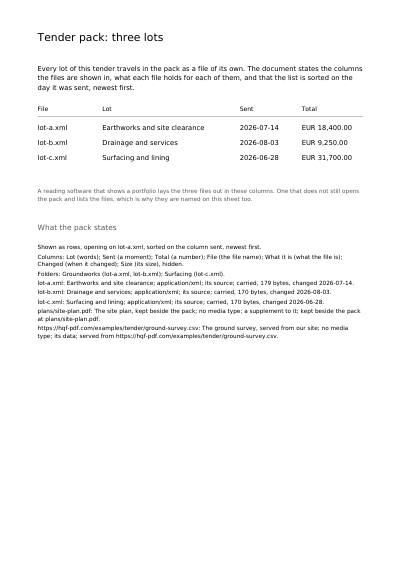
Three firms answer a call for tenders, and what arrives is three sets of figures that have to stay apart and travel together. Each lot goes into this document as a file of its own, whole, in the shape it was sent in. What turns that from a bag of attachments into a pack somebody can work through is the rest: the document names the columns the files are shown under — the lot, the day it was sent, what it comes to — says what each file puts in each of them, and says the list is sorted on the day, newest first.
Without that, reading software has nothing to show but a list of file names, which tells a buyer neither which lot came in when nor for how much. With it, the three lots come up as a table that sorts. And because not every reading software shows a pack at all, the cover sheet lays the same columns out on the page itself: whoever opens the document sees what is inside it either way, and the files are still there to be taken out one by one.
Nothing is left out and nothing is simplified: this is the program exactly as it runs, for whoever writes your software. The third is the description itself: a plain list of what the page has to say, which is what the service is sent.
Read the Rust source Read the Python source Read the JSON source
An invoice whose lines and totals fall where the text puts them, and whose square code lets a telephone pay the exact sum into the exact account with nothing retyped.
The note that travels with the goods: a barcode against each article, a box the receiver ticks, and the consignment's own code.
A payslip: eighteen contribution lines with employee and employer shares, the month against the year to date.
A services agreement over two pages where no clause is ever cut in half by a page turn, ending in signature, name and date fields filled in on screen.
A certificate whose border, ribbon and seal are drawn as lines rather than photographed: sharp at any size, and a fraction of the weight.
A boarding pass carrying, as a square code, the one line the gates at an airport read — one character out of place and it is refused.