A Month's Report, Its Charts Drawn in Curves
A pie of where the hours went, a ring gauge of how far into the year the work is, a card with eased corners, and arcs told where to go rather than how far to turn.
A gradient runs in a straight line or out from a point, and that covers most of what a page asks for. It does not cover a background whose colour turns a corner, a map shaded from readings taken in twenty places, or a picture of heat where every spot has its own value. The usual way out is to build the picture in a drawing program and drop it in — and then it is a photograph of colour: heavy inside the file, fixed at the size it was made at, and soft at the edges the moment somebody prints the page larger.
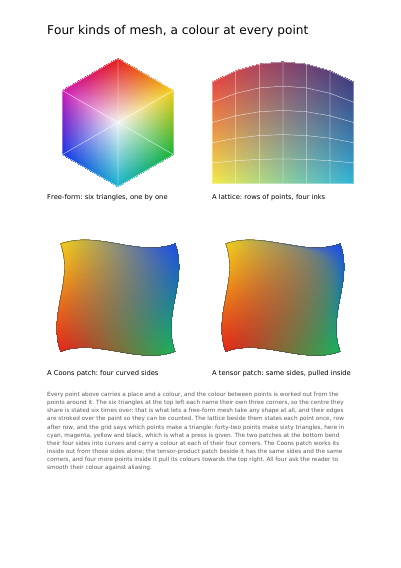
A mesh is the other answer, and it stays a description rather than a picture. It is given corners, each saying where it stands and what colour sits there, and the colour anywhere between them is worked out from the corners around it. Nothing is kept spot by spot, so the file stays small and the page stays sharp at any size. The PDF format has four kinds of mesh, and the page below shows one of each. At the top left, six triangles meet at a centre held almost white, their outer corners running round the colour wheel; each triangle names its own three corners, which is what lets this kind take any shape at all, and their edges are stroked over the paint so they can be counted. Beside them, a lattice states each point once, row after row, and the grid says which points make a triangle: forty-two points make sixty triangles, here in cyan, magenta, yellow and black, which is what a press is given. At the bottom, two patches bend their four sides into curves and hold a colour at each corner. The first, a Coons patch, works its inside out from its sides alone; the second, a tensor-product patch, has the same sides and the same corners, and four more points inside it pull its colours towards the top right.
Nothing is left out and nothing is simplified: this is the program exactly as it runs, for the developer who uses this library. The third is the description itself: a plain list of what the page has to say, which is what the service is sent.
Read the Rust source Read the Python source Read the JSON source
Open the document in English Open the document in French Open the document in German Open the document in Spanish Open the document in Italian Open the document in Portuguese
A pie of where the hours went, a ring gauge of how far into the year the work is, a card with eased corners, and arcs told where to go rather than how far to turn.
The same area of stripes shown through two windows: a plain disc, and a ring whose middle is left bare.
Half-transparent fills that overlap and mix, one orange square laid over a blue bar in four different ways of mixing colours, and a line of overlapping letters painted two ways.
Five panels: a header that fades out, the same fade on the diagonal, a glow carried past its own circle so the corners fill, a blend that goes by way of a third colour, and a checkerboard whose colour is worked out from where each point stands, redder to the right and greener towards the top.
A gradient used as the colour something is filled with: a headline whose letters are windows onto a blend of three colours, a panel filled with a circular one that lets the page show through, and a band whose blend is stood upright and whose border is painted with the circular one.
The same floor plan on six layers shown and hidden one at a time: the furniture and the distances shown, the internal notes hidden until asked for, and a draft watermark meant for the screen and not for the paper.