A delivery note that knows its own order

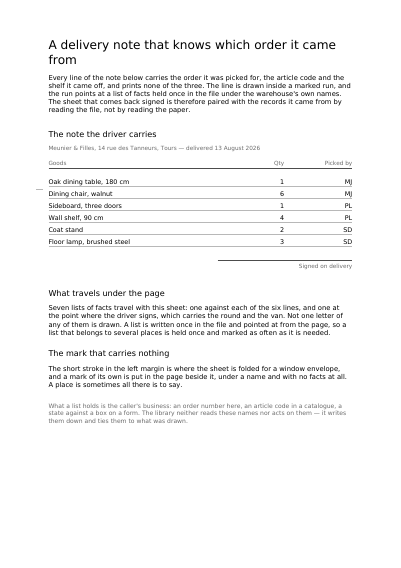
A warehouse prints a note for the driver and keeps a record for itself. Three days later the signed sheet comes back, and somebody has to put it beside the record it belongs to. Printing the codes on the note would settle that in a moment, at the price of a column of machine words down a sheet a customer reads and signs.

So the codes travel under the page instead. Each line of the note is drawn with a list of facts attached to it — the order it was picked for, the article code, the shelf it came off — under names the warehouse chose itself; the place where the driver signs carries the round and the van. Not one letter of any of it is drawn. A program reading the file finds every code against the line it belongs to, and a customer reading the sheet finds a delivery note. The last mark on the page carries nothing at all: it sits beside the fold tick, and where it is is the whole of what it says.

What this example shows

  • The names and the values are yours; they are written down and tied to what was drawn.
  • Nothing of them is printed: the sheet a customer reads is unchanged.
  • A list is written once and pointed at from each place it belongs.

The code that writes it, in full

Whole programs, hundreds of lines long, for whoever writes your software.

Read the Rust source Read the Python source

The document itself

Open the document in English Open the document in French

Examples near this one

A sheet that measures what it says

Three rulers — centimetres, inches and points — on a page that tells whatever prints it to put it out at exactly the size it was drawn, and to offer nothing else. Lay a tape measure on the printed sheet and you can check for yourself.

A register whose pages say where they came from

Two sittings bound into one file. Each page carries a record of its own — what it is, whose hand wrote it, the day it was written — the photograph on the second page carries one too, and each transcription is tied to the page it transcribes rather than to the file at large.

A file that explains its own fields

A records office's reference, the department it came from, the date until which the sheet must be kept and its classification, carried inside a file an archive still accepts. No rule anywhere knows what a keep-until date is, so each field arrives with a description of itself — and that description is what makes a checking program accept information nobody but you invented.

A document that can be read aloud

Two pages carrying a copy of themselves that nobody sees: this is a heading, this is a table, and this is the order to read them in. Software reading the document aloud follows that instead of the order the marks were drawn in, and skips the running head. On the page, nothing looks any different.

A list whose pictures speak too

A parts list whose first column is a picture rather than a word. Each picture carries the sentence somebody hears in its place, so nothing in the list is lost on a reader who cannot see it. On the page, the pictures are simply pictures.

An invoice a machine reads too

One invoice read twice: a person sees the page, and accounting software reads the same amounts out of the same file without anybody retyping them. Nothing to reconcile afterwards, because there is only ever one document.

Every example, by subject