Inks on plates of their own
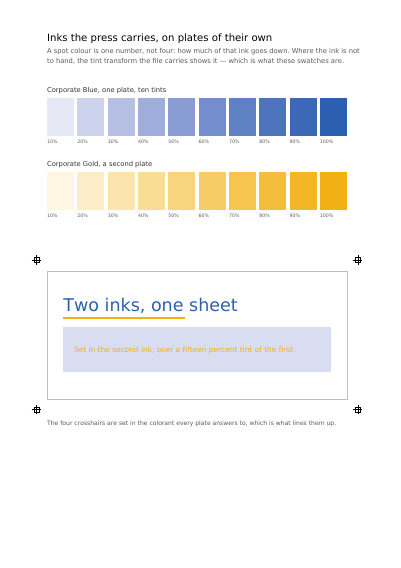
Two inks the press carries on a plate of their own, each at ten strengths, a piece of work set in both, and the crosses used to line the plates up — drawn in an ink every plate answers to.
A spot colour is not mixed out of the four usual inks: it is an ink of its own, on a plate of its own, and a colour in it is one number — how much of it goes down. The first page carries two such inks at ten strengths each and a piece of work set in both; the second prices a print job with those two and nothing else, where the table, the paragraph under it and the word across it are all press ink.
What that single number looks like where the ink does not exist — on a screen, or on a press that does not carry it — is what the conversion recipe says, and the file carries one. The alignment crosses are drawn in an ink every plate answers to, so they come out on all of them, which is what lets the plates be laid exactly over one another.
What this example shows
- Named inks separated onto plates of their own, used for a table and a paragraph as readily as for a shape.
- A conversion recipe, saying what the ink looks like when you do not have it.
- Alignment crosses that print on every plate.
The code, in full
The same document is written twice, once in each language. Both files are shown in full, with the code coloured on the server, and can be copied in one click.
The document itself
The document this example writes, ready to open.
Open the document in English
Read the Rust source
Read the Python source