Grey, screen and printing colours

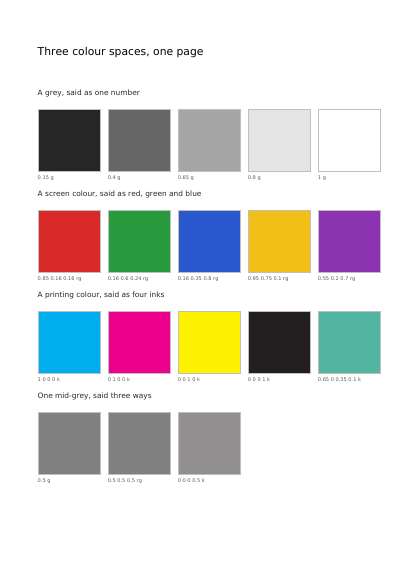
Swatches in each of the three ways to say a colour — a grey as one number, a screen colour as three, a printing colour as four inks — each captioned with the instruction actually written into the file, and one mid-grey said three ways.

A colour is written the way it was named: a grey as one number, a screen colour as three, a printing colour as four inks. This page shows the three together, and captions each swatch with the instruction it actually put in the file, so what the library writes is never something to take on trust.

The bottom row is the interesting one: one mid-grey said three ways. The same ink on paper, three different sets of numbers in the file. Which of the three a document should use depends on where it is going, not on how it looks on the screen you are reading it on.

What this example shows

  • Greyscale, RGB and CMYK swatches on one page.
  • Each swatch captioned with the instruction written for it.
  • One grey said all three ways, for comparison.

The code, in full

The same document is written twice, once in each language. Both files are shown in full, with the code coloured on the server, and can be copied in one click.

The document itself

The same document is written in each of these languages. Open the one you want to look at.

Open the document in English Open the document in French

Read the Rust source Read the Python source

First page of Grey, screen and printing colours

What this document weighs

Before 110,363 bytes
Now 39,815 bytes
Saved 63.9 %

Not one mark on the page changed. See every document measured.

Examples near this one

Colour the document defines

The same six colours said as bare numbers and then read through the sRGB profile the file carries, plus a ramp from light to dark and a sweep of hues in CIE L*a*b*: colour that still means the same thing on another screen and on a press.

Inks on plates of their own

Two inks the press carries on a plate of their own, each at ten strengths, a piece of work set in both, and the crosses used to line the plates up — drawn in an ink every plate answers to.

Several plates at once, each at a strength of its own

Eight choices of plate among the four usual inks, each with the small program that shows it printed underneath, and two inks the press carries itself used together, every strength of one against every strength of the other.

A chart of colours, and a drawing that names places in it

A chart of house colours the file carries, and a drawing whose sixteen numbers are places in that chart rather than colours. The same drawing is shown twice through two charts: repainting a whole brand is one table, not every drawing.

One hatch, laid down in as many colours as the page asks for

One pattern that states no colour of its own, laid down in five colours and in five strengths of one press ink: the fill says what colour to lay it down in. Beside them, the same hatch made of patterns that carry their own colours, which is one pattern per colour.

A sheet as it goes to the press

One drawing on three pages: a press sheet stating where the ink runs, where the blade falls and what is worth keeping, with corner marks; the same sheet cropped to the finished page; and a landscape page that states a quarter turn clockwise on an upright sheet.

Every example, by subject

Glossary

CMYK
The four inks a printing press lays down: cyan, magenta, yellow and black. A screen mixes light instead, so a document going to a press states its colours in inks, not in screen colours.