Archiving, accessibility and metadata

Documents that will still open decades from now, that a screen reader can read aloud, and that an accounting system can book without anyone retyping them.

Some documents have to outlive the software that created them. An archival PDF carries everything it needs inside it — the fonts, what its colours mean, a description of itself — so that nothing it depends on can go missing later. Public bodies and long-term archives ask for exactly that, and there are programs that check it.

The same care is what makes a document readable by somebody who cannot see it. The file can carry its own structure — this is a heading, this is a table, this is the wording that stands for a picture — so a screen reader announces the page in a sensible order rather than in the order the marks were drawn.

What It Saves You

An archive accepts the document
The archival samples shown here are handed to a checker with no hand in writing them before a change enters the library, and a refusal stops the check where it stands. That checker is free, and it runs on the copy you download: the claim on the page is one you can settle yourself.
An accounting system books the invoice without a person
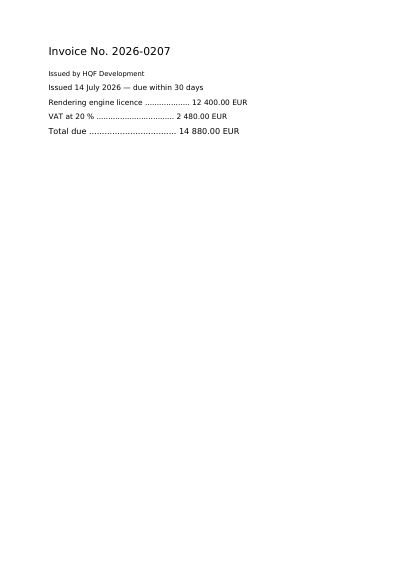
The very page a person reads carries inside it the same invoice in the form a machine books from. Business-to-business invoicing in France is moving to exactly this.
A reader who cannot see it can still read it
A document that carries its own structure is announced in order, with its pictures described, instead of arriving as one undifferentiated block of text.

See It Done

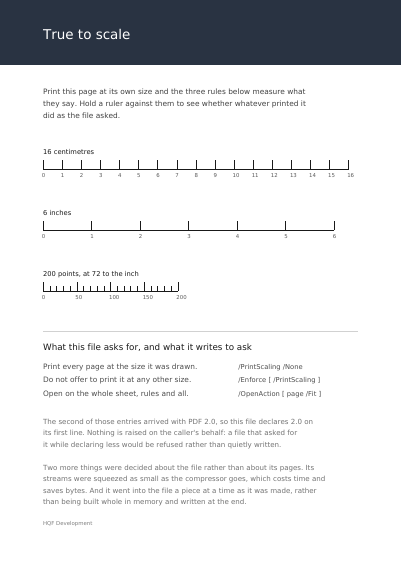
A Sheet That Measures What It Says, first page

A Sheet That Measures What It Says

Three rulers — centimetres, inches and points — on a page that tells whatever prints it to put it out at exactly the size it was drawn, and to offer nothing else. Lay a tape measure on the printed sheet and you can check for yourself.
A Register Whose Pages Say Where They Came From, first page

A Register Whose Pages Say Where They Came From

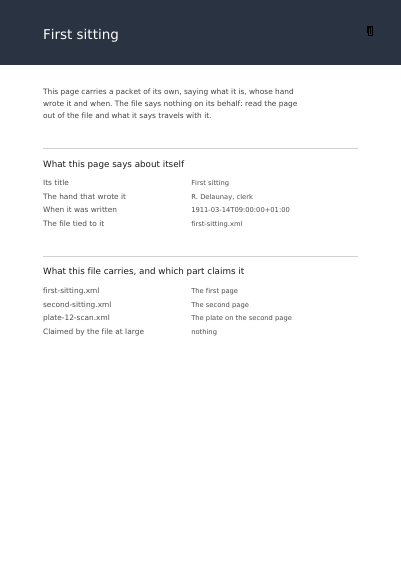
Two sittings bound into one file. Each page carries a record of its own — what it is, whose hand wrote it, the day it was written — the photograph on the second page carries one too, and each transcription is tied to the page it transcribes rather than to the file at large.

A File That Explains Its Own Entries, first page

A File That Explains Its Own Entries

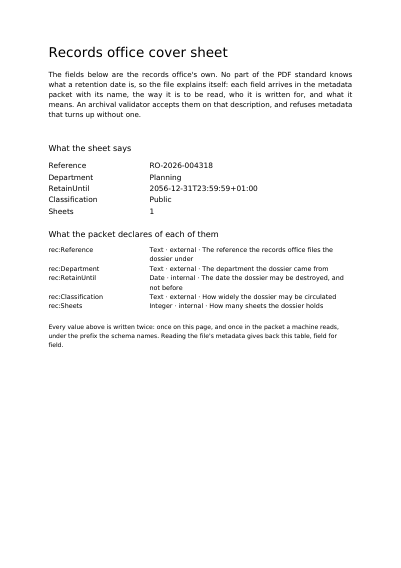
A records office's reference, the department it came from, the date until which the document must be kept and its classification, carried inside a file an archive still accepts. No archiving rule knows what a keep-until date is, so each entry carries a description of itself, and that description is what makes a checker accept a fact you alone invented. A second page adds a loan record whose entries are a yes or no, a type of file, a person's name, a measurement and two web addresses, and gives that page a hidden record of its own.

A Delivery Note That Knows Its Own Order, first page

A Delivery Note That Knows Its Own Order

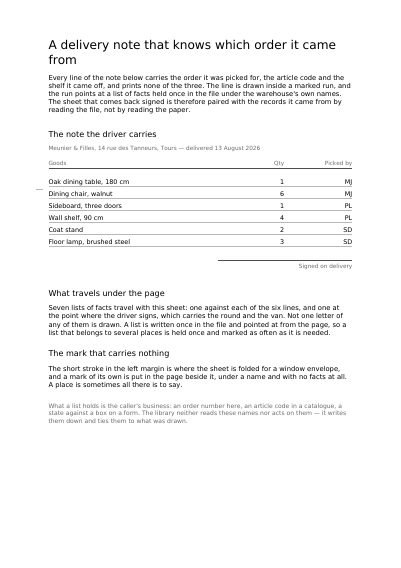
Every line of the note carries the order it was picked for, the article code and the shelf it came off, and prints none of them. The place where the driver signs carries the round and the van, and one beside the fold tick carries nothing but its own place.

A Document That Can Be Read Aloud, first page

A Document That Can Be Read Aloud

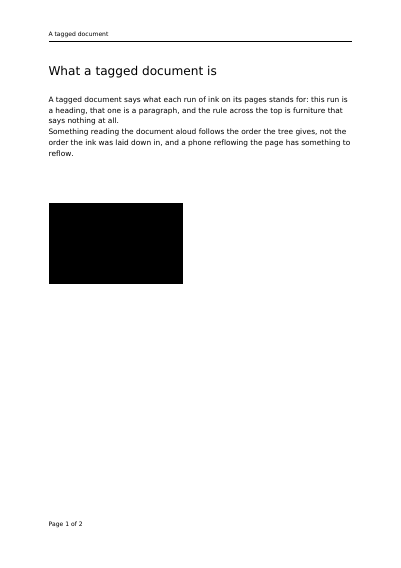
Two pages carrying a copy of themselves that nobody sees: this is a heading, this is a table, and this is the order to read them in. Software reading the document aloud follows that instead of the order the marks were drawn in, and skips the running head. On the page, nothing looks any different.

A List Whose Pictures Speak Too, first page

A List Whose Pictures Speak Too

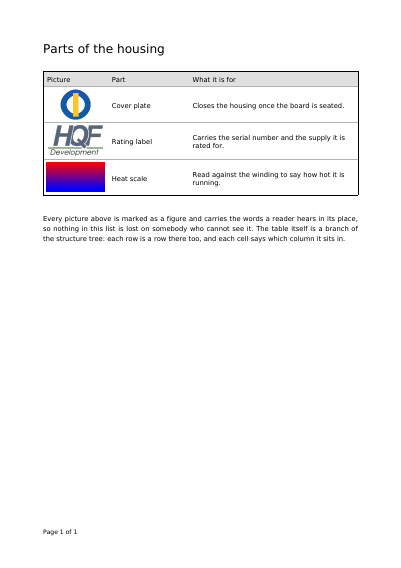
A parts list whose first column is a picture rather than a word. Each picture carries the sentence somebody hears in its place, so nothing in the list is lost on a reader who cannot see it. On the page, the pictures are simply pictures.

A Tagged Notice That Says What Each Part Is, first page

A Tagged Notice That Says What Each Part Is

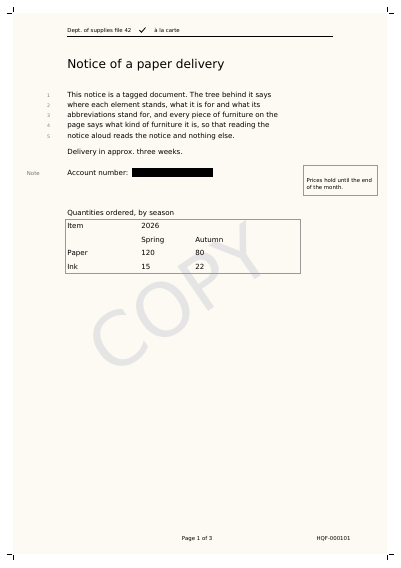
A delivery notice whose hidden structure says where each element stands, what an abbreviation stands for and which headings each table cell belongs to, with its running head, page number and line numbers marked as page furniture; then every list numbering and every role an element can be given.

An Invoice That Asks Before It Claims, first page

An Invoice That Asks Before It Claims

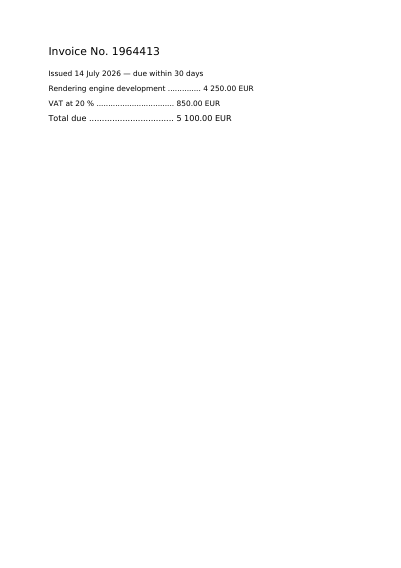
The library reads the invoice as it stands and names, clause by clause, everything between it and Factur-X. Two things stand in the way, then one, then none — and only then is a file written.

A Tagged PDF/A-1a Deed of Deposit, first page

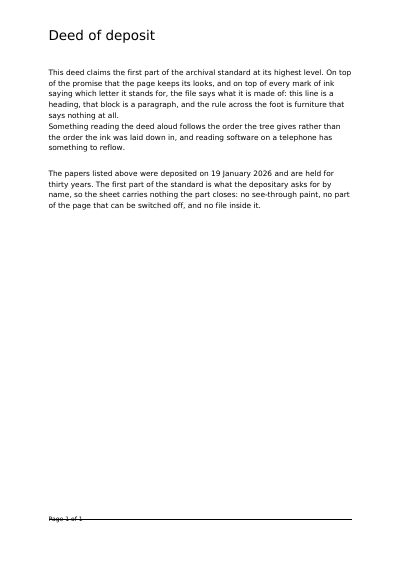
A Tagged PDF/A-1a Deed of Deposit

The first part of the archival standard at its highest level: the page also says which line is the heading, which blocks are paragraphs and what is mere decoration.

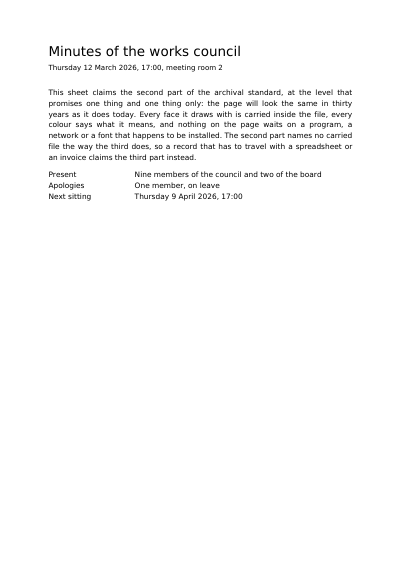
PDF/A-2b Minutes Kept for Thirty Years, first page

PDF/A-2b Minutes Kept for Thirty Years

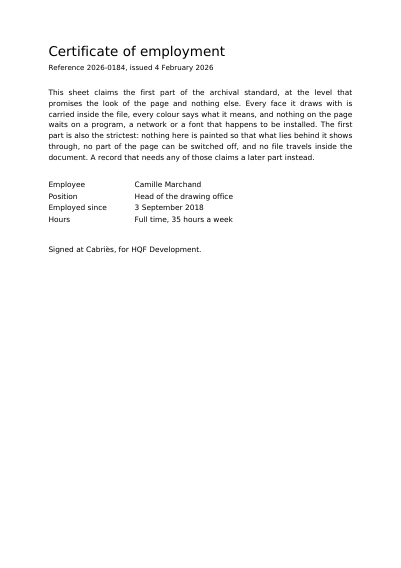
Minutes of a works council written to the second part of the archival standard, at the level that promises only that the page will look the same in thirty years.

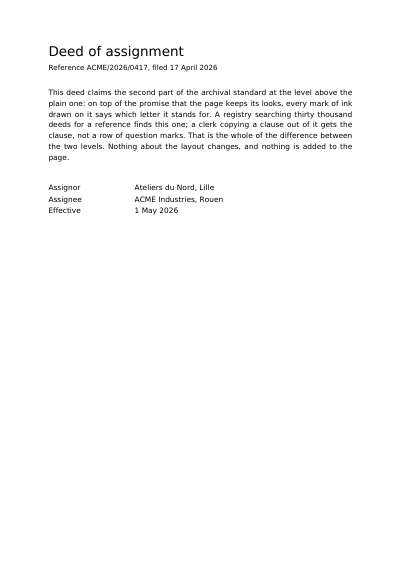
A Searchable PDF/A-2u Deed of Assignment, first page

A Searchable PDF/A-2u Deed of Assignment

The level above the plain one: every letter on the page can be searched and copied out, so a registry finds the deed and a clerk copies a clause as it stands.

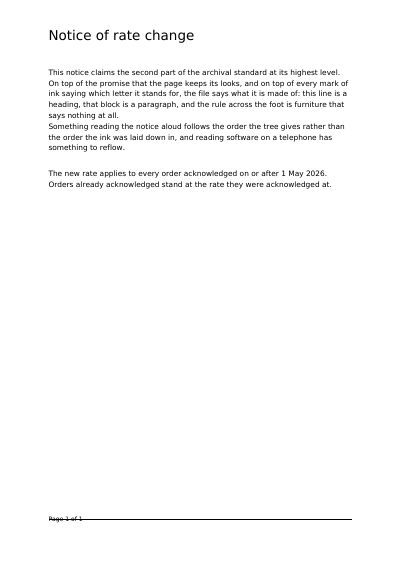
A Tagged PDF/A-2a Notice of Rate Change, first page

A Tagged PDF/A-2a Notice of Rate Change

A notice written to the second part of the archival standard at its highest level, which software reading aloud follows in the order the text is meant to be read in.

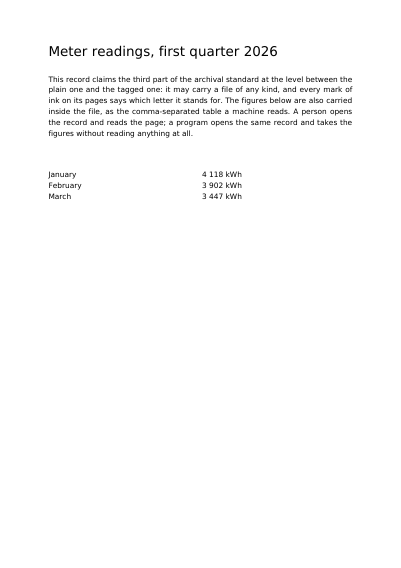
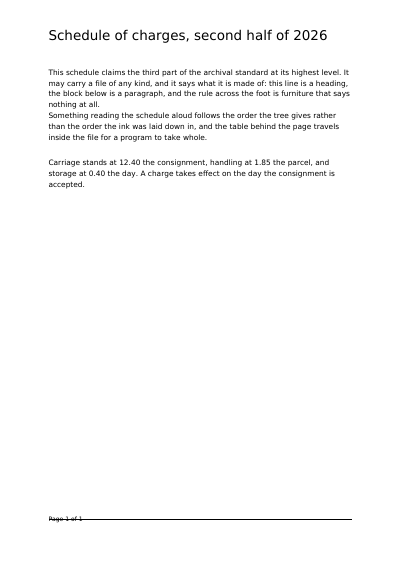
A Tagged PDF/A-3a Schedule of Charges, first page

A Tagged PDF/A-3a Schedule of Charges

A schedule a screen reader follows and a program reads from the table attached inside it: the third part of the archival standard at its highest level.

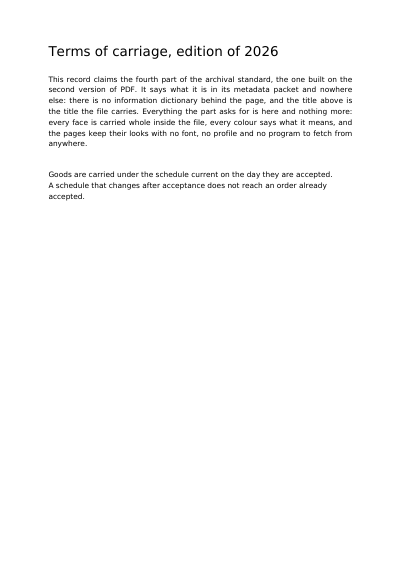
PDF/A-4 Terms of Carriage on PDF 2.0, first page

PDF/A-4 Terms of Carriage on PDF 2.0

Terms of carriage written to the fourth part of the archival standard, the one built on PDF 2.0, which drops the A, B and U levels of the earlier parts.