A sheet that measures what it says

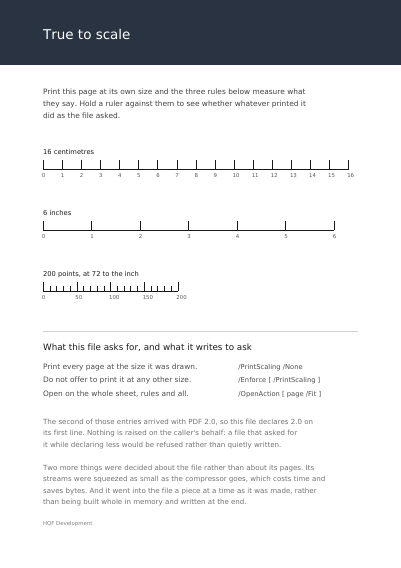
Three rules — centimetres, inches and points — on a page that states it must print at exactly the size it was drawn, and that the reader is to offer nothing else. That second request only exists from PDF 2.0 on, so the file declares 2.0 rather than changing version without you knowing.

A drawing printed to be measured is worth nothing if the printer shrinks it to fit its own margins. This page carries three rules — centimetres, inches and points — and states in the file itself that it must print at exactly the size it was drawn, and that the reader is to offer nothing else.

That second request only exists from PDF 2.0 on, so the file declares 2.0. Nothing is raised on your behalf, and a file asking for it while declaring an older version is refused rather than written. The example also shows the two other decisions that cover a whole file: how hard its content is squeezed, and writing straight to disk as it goes instead of building the whole document in memory.

What this example shows

  • A page that asks to be printed at its true size.
  • Rules in three units, drawn to be measured with a ruler.
  • Compression of the content, and writing as it goes: both your decision.

The code, in full

The same document is written twice, once in each language. Both files are shown in full, with the code coloured on the server, and can be copied in one click.

The document itself

The same document is written in each of these languages. Open the one you want to look at.

Open the document in English Open the document in French

Read the Rust source Read the Python source

First page of A sheet that measures what it says

What this document weighs

Before 113,086 bytes
Now 42,783 bytes
Saved 62.2 %

Not one mark on the page changed. See every document measured.

Examples near this one

A register whose every part says where it came from

Two sittings bound into one file. Each page carries a record of its own — what it is, whose hand wrote it, when — the photograph on the second page carries one too, and each transcription is tied to the page it transcribes rather than to the file at large. Tying an attached file to anything but the whole document only exists from PDF 2.0 on, so the file declares 2.0.

An archival sheet carrying fields of its own

A records office's reference, the department it came from, the date until which the document must be kept and its classification, in a PDF/A-3 file. No standard knows what a retention date is, so each field arrives with a description of itself — its type, who it is written for, what it means — which is what makes a checker accept information you invented. The page prints the same list, so what a person reads and what a machine reads cannot drift apart.

A tagged, accessible document

A document that says what each run of ink stands for, and which runs are only trimmings. Its text and its table describe themselves, a paragraph and a cell at a time. Validates as PDF/A-3a and PDF/UA-1.

A tagged list whose column is a picture

A parts list whose first column is a picture rather than a word. Each picture is marked as one and carries the words a reader hears in its place, so nothing in the list is lost on somebody who cannot see it. Validates as PDF/A-3a and PDF/UA-1.

A sheet as it goes to the press

One drawing on three pages: a press sheet stating where the ink runs, where the blade falls and what is worth keeping, with corner marks; the same sheet cropped to the finished page; and a landscape page that states a quarter turn clockwise on an upright sheet.

Every example, by subject

Glossary

request
One call to the service: you send what the document should say, and get the document back. What is counted for billing is these calls, and the pages they came to.