A register whose every part says where it came from
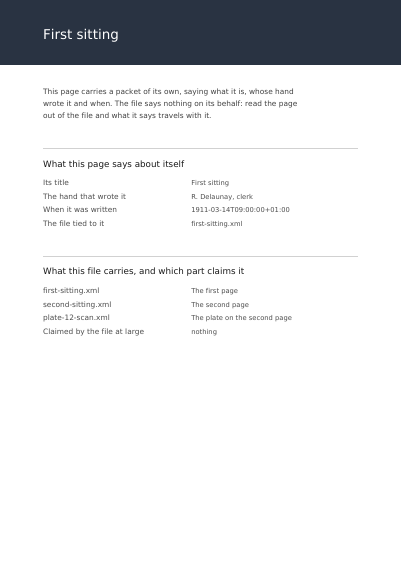
Two sittings bound into one file. Each page carries a record of its own — what it is, whose hand wrote it, when — the photograph on the second page carries one too, and each transcription is tied to the page it transcribes rather than to the file at large. Tying an attached file to anything but the whole document only exists from PDF 2.0 on, so the file declares 2.0.
A document says what it is, and that has always been written once, for the whole file. It is not enough for anything assembled out of pieces: a register bound from two sittings, or a scan whose photograph belongs to somebody other than whoever holds the paper.
Here each page carries a record of its own — what it is, whose hand wrote it, when — the photograph on the second page carries one too, and each attached transcription is tied to the page it transcribes rather than to the file at large. Tying an attachment to anything but the whole document only exists from PDF 2.0 on, so the file declares 2.0 rather than changing version without you knowing.
What this example shows
- A metadata packet on a page, and another on an image.
- Attachments tied to the page they belong to, not to the file.
- PDF 2.0 declared on purpose, never raised in silence.
The code, in full
The same document is written twice, once in each language. Both files are shown in full, with the code coloured on the server, and can be copied in one click.
The document itself
The same document is written in each of these languages. Open the one you want to look at.
Open the document in English
Open the document in French
Read the Rust source
Read the Python source