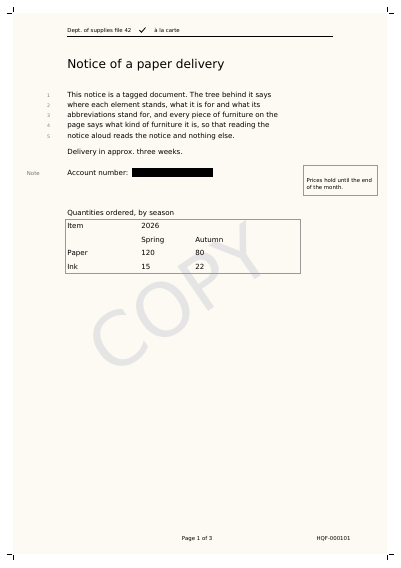
A Tagged Notice That Says What Each Part Is

A person who cannot see the page hears it read aloud by a screen reader, and the screen reader can only say what the file tells it. Here a notice of a paper delivery is tagged down to its smallest part: the tree behind the page says where each element stands on the line, what it is for, what an abbreviation stands for, and which column and row headings each figure of the table sits under, even where a heading spans several rows or columns.

Everything that is not the text itself is marked as furniture, each piece by its kind: the background, a watermark, the running head, the line numbers, the page number, a legal filing number, a blacked-out area and the trim marks, so that reading the notice aloud reads the notice and nothing else. The second page shows a list in every numbering a list can state, the third names every role an element can be given, and a bookmark leads straight to one heading cell of the table.

What This Example Shows

  • Each part says what it is and where it stands.
  • Every piece of page furniture marked by its kind.
  • Table cells tied to the headings above and beside them.

The Source Code, Complete

Nothing is left out and nothing is simplified: this is the program exactly as it runs, for the developer who uses this library.

Read the Rust source Read the Python source

The Document Itself

Open the document in English Open the document in French Open the document in German Open the document in Spanish Open the document in Italian Open the document in Portuguese

A Tagged Notice That Says What Each Part Is, first page

The Same Document in Other Languages

This document weighs 63.0 kB

Examples Near This One

A Sheet That Measures What It Says

Three rulers — centimetres, inches and points — on a page that tells whatever prints it to put it out at exactly the size it was drawn, and to offer nothing else. Lay a tape measure on the printed sheet and you can check for yourself.

A Register Whose Pages Say Where They Came From

Two sittings bound into one file. Each page carries a record of its own — what it is, whose hand wrote it, the day it was written — the photograph on the second page carries one too, and each transcription is tied to the page it transcribes rather than to the file at large.

A File That Explains Its Own Entries

A records office's reference, the department it came from, the date until which the document must be kept and its classification, carried inside a file an archive still accepts. No archiving rule knows what a keep-until date is, so each entry carries a description of itself, and that description is what makes a checker accept a fact you alone invented. A second page adds a loan record whose entries are a yes or no, a type of file, a person's name, a measurement and two web addresses, and gives that page a hidden record of its own.

A Delivery Note That Knows Its Own Order

Every line of the note carries the order it was picked for, the article code and the shelf it came off, and prints none of them. The place where the driver signs carries the round and the van, and one beside the fold tick carries nothing but its own place.

A Document That Can Be Read Aloud

Two pages carrying a copy of themselves that nobody sees: this is a heading, this is a table, and this is the order to read them in. Software reading the document aloud follows that instead of the order the marks were drawn in, and skips the running head. On the page, nothing looks any different.

A List Whose Pictures Speak Too

A parts list whose first column is a picture rather than a word. Each picture carries the sentence somebody hears in its place, so nothing in the list is lost on a reader who cannot see it. On the page, the pictures are simply pictures.

Every example, by subject