A list whose pictures speak too

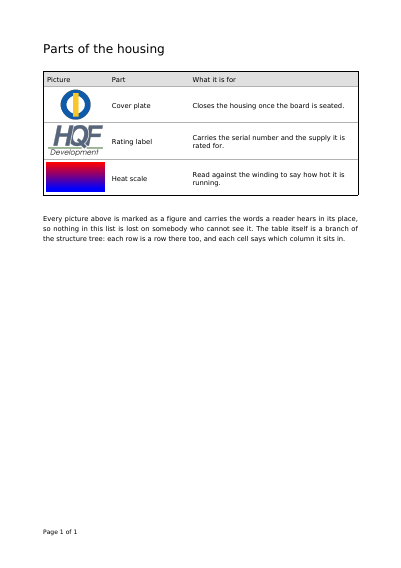
Read a parts list down the telephone and you say what each picture shows: the lid, the rating plate, the little heat gauge. Software reading a document aloud says nothing at all, because a picture is only a picture to it — and in a list where the picture is the column that tells one article from another, that is not a lost decoration. It is the whole row going silent.

Each of the three pictures here carries a sentence written for that one moment: the words somebody hears in place of the image. Every cell says which column it belongs to as well, so a row is read out as a row and not as four stray words. Public bodies are now obliged to get this right, and so is everybody who supplies them — and it costs the document nothing you can see: on the page, the pictures are simply pictures.

What this example shows

  • Three articles in a list, each named by a picture rather than a word.
  • A sentence attached to every picture, heard in place of it.
  • Every cell naming the column it belongs to, so a row is read out as a row and not as four stray words.

The source code, complete

Nothing is left out and nothing is simplified: this is the program exactly as it runs, for the developer who uses this library. The third is the description itself: a plain list of what the page has to say, which is what the service is sent.

Read the Rust source Read the Python source Read the JSON source

The document itself

Open the document in English Open the document in French

Examples near this one

A sheet that measures what it says

Three rulers — centimetres, inches and points — on a page that tells whatever prints it to put it out at exactly the size it was drawn, and to offer nothing else. Lay a tape measure on the printed sheet and you can check for yourself.

A register whose pages say where they came from

Two sittings bound into one file. Each page carries a record of its own — what it is, whose hand wrote it, the day it was written — the photograph on the second page carries one too, and each transcription is tied to the page it transcribes rather than to the file at large.

A file that explains its own entries

A records office's reference, the department it came from, the date until which the document must be kept and its classification, carried inside a file an archive still accepts. No archiving rule knows what a keep-until date is, so each entry carries a description of itself, and that description is what makes a checker accept a fact you alone invented.

A delivery note that knows its own order

Every line of the note carries the order it was picked for, the article code and the shelf it came off, and prints none of them. The place where the driver signs carries the round and the van, and one beside the fold tick carries nothing but its own place.

A document that can be read aloud

Two pages carrying a copy of themselves that nobody sees: this is a heading, this is a table, and this is the order to read them in. Software reading the document aloud follows that instead of the order the marks were drawn in, and skips the running head. On the page, nothing looks any different.

Every example, by subject