Breaking a paragraph up, and aligning it
A paragraph broken into lines, then laid out four ways: left, right, centred, justified.
A newsletter, a leaflet, the terms on the back of an order form: as soon as a page holds more words than one column can carry comfortably, the text has to run from the foot of one into the head of the next. It is a common layout, and the answer changes the moment a single word does.
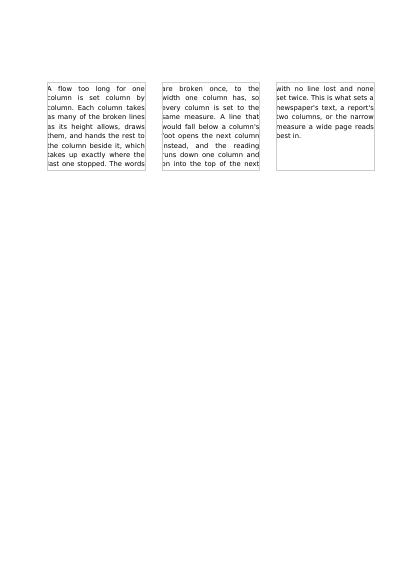
Here the passage is measured once and then poured: the first column takes as many lines as its height allows, hands the rest to the second, and the second to the third. Add a sentence at the top and everything below it shuffles down of its own accord, across all three. A thin rule is drawn round each column on this page, so the text can be seen reaching the foot of one and carrying on at the head of the next.
Nothing is left out and nothing is simplified: this is the program exactly as it runs, for the developer who uses this library. The third is the description itself: a plain list of what the page has to say, which is what the service is sent.
Read the Rust source Read the Python source Read the JSON source
The document is lighter than it was, and every page still looks exactly the same. See this document's row in the table of every example.
A paragraph broken into lines, then laid out four ways: left, right, centred, justified.
A word longer than the column that holds it: the library leaves it whole, or cuts it at the column's edge.
A justified column set twice: the long words breaking at their soft hyphens with a hyphen shown, or left whole, and a figure a no-break space keeps together.
A justified column set twice: file paths and compounds running past the edge with no break points, then wrapping where a break after a slash or a hyphen is allowed.
A title, a rule, two paragraphs, a heading, a table of twenty-six rows and a footnote, handed over in reading order and broken across two pages by the engine.
One line of statuses set twice: in a company font alone, where the characters it has no glyph for come out as empty boxes, then with a second font behind it that draws them.