Custom page labels

Pages numbered by their labels rather than their position.

The number you type to go to a page ought to be the number printed on that page. That is what page labels are for: the opening pages in lower-case roman, an inserted plate with a label of its own, then ordinary numbering that starts again at one where the body starts.

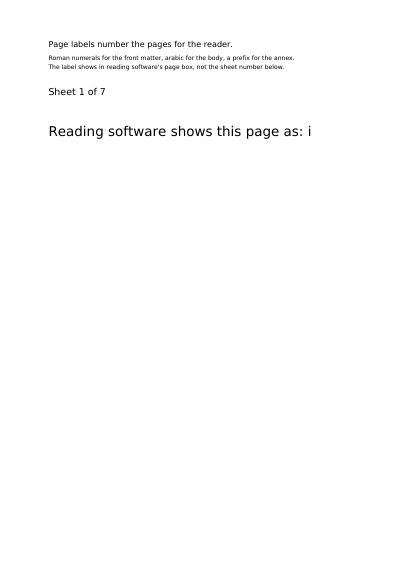
Whether the labels work is not a question the file can answer: the answer is in the box you type a page number into, the one place they show. So every page in this document says what a reader ought to be showing for it — open the file, and the two either agree or they do not.

What this example shows

  • Roman, arabic and lettered numbering in one document.
  • A prefix carried in front of the number, per range.
  • Numbering that starts again wherever you decide.

The code, in full

The same document is written twice, once in each language. Both files are shown in full, with the code coloured on the server, and can be copied in one click.

The document itself

The same document is written in each of these languages. Open the one you want to look at.

Open the document in English Open the document in French

Read the Rust source Read the Python source

First page of Custom page labels

What this document weighs

Before 113,543 bytes
Now 43,049 bytes
Saved 62.1 %

Not one mark on the page changed. See every document measured.

Examples near this one

A slideshow that runs itself

Thirteen slides, each stating the effect it arrives by — all twelve the standard defines — how long that effect takes and how long the slide stands before the next one comes. The file opens full screen, which is the only place a reader reads any of it.

A handbook that says how it wants to be read

Four pages that state what happens the moment the file is opened: which page it opens on and how much of the window that page fills, the bookmarks shown beside it, the pages two at a time, a print dialogue already filled in, and the address its relative links are read against.

Links and marks on placed text

Links and marks hung on text the engine has already placed: a band behind a line, an underline, a boxed cell — every rectangle taken from what the layout and the table report afterwards, none of it measured by hand.

A tagged, accessible document

A document that says what each run of ink stands for, and which runs are only trimmings. Its text and its table describe themselves, a paragraph and a cell at a time. Validates as PDF/A-3a and PDF/UA-1.

Every example, by subject