A pack built on three supplied sheets
A supply agreement standing on three PDF files the customer sent: a headed sheet under the front page, a plain sheet under every page the schedule runs to, and a page of conditions that goes in whole.
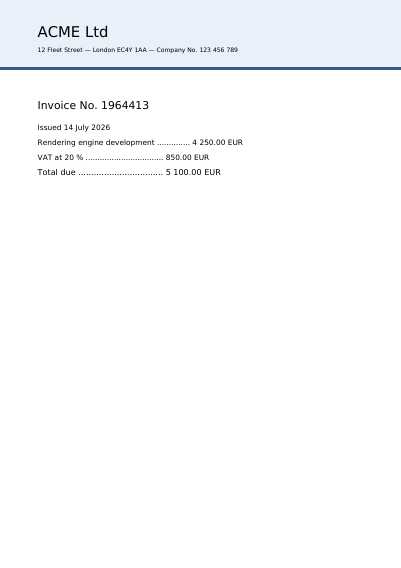
An invoice laid on a letterhead somebody else made.
The letterhead already exists as a PDF somebody else made: a page with a header block on it and nothing else. It is read, brought in as a drawing, laid under the new page, and the invoice is set on top of it.
Nothing about the letterhead is rewritten: its fonts, its colours and its marks come across exactly as they are. This is how a document server uses the letterhead a customer supplies without having to understand, or set again, anything on it.
The same document is written twice, once in each language. Both files are shown in full, with the code coloured on the server, and can be copied in one click.
The same document is written in each of these languages. Open the one you want to look at.
| Before | 218,913 bytes |
|---|---|
| Now | 77,869 bytes |
| Saved | 64.4 % |
Not one mark on the page changed. See every document measured.
A supply agreement standing on three PDF files the customer sent: a headed sheet under the front page, a plain sheet under every page the schedule runs to, and a page of conditions that goes in whole.
What an unlicensed copy looks like: the evaluation watermark the library stamps on every page.
A form a reader fills in: text boxes, a check box, a drop-down, radio buttons.
A form that is also a PDF/A-3 file: every field already drawn, with a visible frame, expecting nothing from the reader's software.
Pages numbered by their labels rather than their position.
A document that says what each run of ink stands for, and which runs are only trimmings. Its text and its table describe themselves, a paragraph and a cell at a time. Validates as PDF/A-3a and PDF/UA-1.