An Invoice Laid on a Letterhead Template
An invoice laid over a letterhead supplied as a PDF file.
A program that receives a form and answers it, a bank opening an account or an insurer completing a claim, must not rewrite the file it was sent: a signature already on it covers its bytes, and a copy kept for the record has to stay what it was. The answers go in as a section added to the end of the file, and everything written before stays where it was.
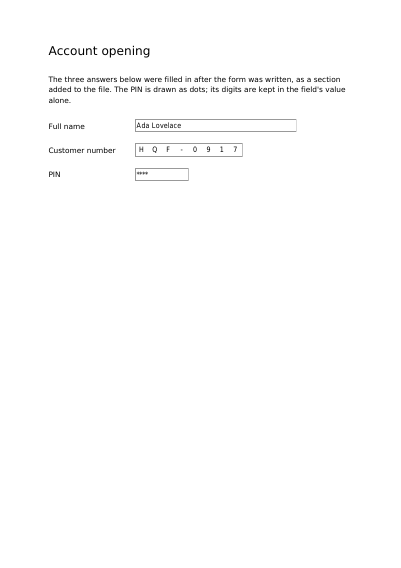
Each answer is drawn into the field it fills, so the page shows it in reading software that draws nothing itself. The customer number takes one box of its comb per character. The PIN is drawn as one dot per digit; the digits are kept in the field's value, and never drawn on the page.
Nothing is left out and nothing is simplified: this is the program exactly as it runs, for the developer who uses this library.
Read the Rust source Read the Python source
Open the document in English Open the document in French Open the document in German Open the document in Spanish Open the document in Italian Open the document in Portuguese
An invoice laid over a letterhead supplied as a PDF file.
A maintenance agreement somebody else sent, with a signature area, a date and a line of one's own laid over its last page, an annex added after it and an empty place to sign over the signature area, every byte of the agreement left where it was.
A supply agreement standing on three templates the customer sent: a headed page under the front page, a plain page under every page the schedule runs to, and a page of conditions that goes in whole.
A delivery label on which a designer named four rectangles, read back from its own file, placed four times and filled by those names alone: an address, an order number, a logo drawn from an SVG file and a return slip.
What you get before you pay anything: a watermark across every page, and the same pages under it, laid out exactly as a paid copy lays them out. This is also the document that says what a licence key changes, and why every figure on this site is measured with one.
A form a reader fills in: text boxes, a check box, a drop-down, radio buttons.