A minimal PDF
The smallest complete file: a page, and shapes drawn on it.
You send out a price list, a report, a set of plans. You want people to read them and print them, and you would rather they did not lift your paragraphs into a document of their own, or change a figure and pass it on. An ordinary PDF gives you no say in any of that: whoever holds the file holds everything in it, in plain sight.
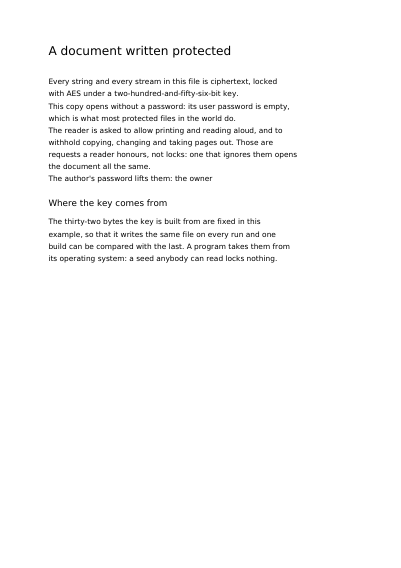
This one holds its own words scrambled. Open it and nothing is asked of you — it reads and prints like any other document. Try to copy from it or edit it, and the reader declines. The page states the author's password, so you can try the other door yourself. And it says plainly what such a file is worth: what a locked document withholds are requests a reader honours, not locks, and a reader that ignores them opens it all the same.
Whole programs, hundreds of lines long, for whoever writes your software.
Read the Rust source Read the Python source
The smallest complete file: a page, and shapes drawn on it.
The same document written twice, the ordinary way and with its first page moved to the head of the file, with how much of each a reader must hold before page one appears.
The same document written twice, plainly and packed, with what each one weighs and what the packing saved.
Text set in a typeface the file carries inside it, cut down to the letters actually used, and still searchable, copyable and readable aloud.
A tick, a cross and a dash drawn by the program, added to the document as a font, and set among ordinary words.
Four faces every reader already draws, set on one page, so the file holds no font at all — and the example weighs the same lines both ways to say what that saves.